
Engineered Stone Built for Real Kitchen Demands
Quartz countertop sales in Dallas for kitchens, baths, and islands requiring low-maintenance, non-porous surfaces
Granite Store Direct carries a focused inventory of engineered stone countertops in Dallas, with particular depth in Cambria—a brand known for consistent pigmentation, tight quartz density, and surface hardness that holds up under daily use. Homeowners replacing laminate or worn granite typically come in with two questions: what colors are available, and what will hold up without constant upkeep. Both of those answers start on the showroom floor with a full slab in hand, not a small sample tile.
The buying process at Granite Store Direct runs from brand and color selection through edge profile choice and layout planning before a purchase is finalized. Cambria slabs are viewed at full size, which matters on islands or L-shaped runs where a small sample cannot show how veining or movement will read across four or five feet of counter. Finish consultation covers polished, matte, and sueded surface options, each with different light-reflection characteristics and tactile feel. Edge profile selection happens alongside layout planning so the client can see how a mitered edge or stacked detail will read against cabinet height and backsplash geometry.
Request a free estimate and full slab viewing to evaluate how specific Cambria colors and finishes will read in your kitchen or bath layout.
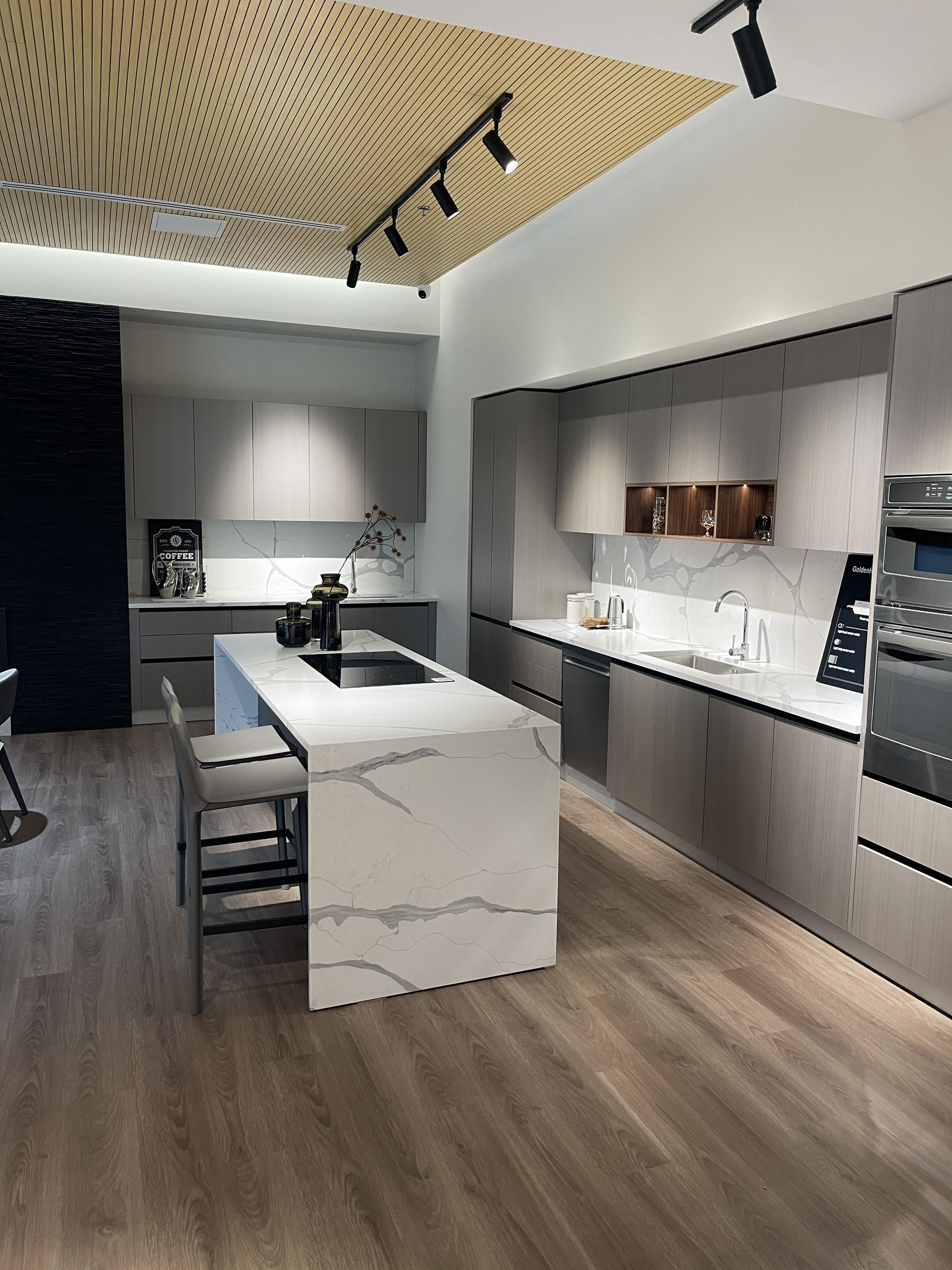
What Engineered Stone Selection Actually Involves
Quartz is not a single product—it is an engineered composite where resin content, quartz particle size, and pigment saturation vary significantly by manufacturer, and those differences show up in how a slab cuts, how it holds an edge profile, and how a polished surface maintains its sheen over years of use. Cambria, for instance, uses a higher quartz concentration than many competing brands, which affects both surface hardness and the clarity of color through the full slab thickness—relevant when an edge is profiled and the cut face is exposed. Understanding those material properties before purchase is what keeps a client from selecting a finish that reads differently in installed form than it did as a sample card.
After slab selection, clients will notice that the layout planning stage resolves questions that do not surface until fabrication begins—specifically, where seams fall on an island or peninsula run, and whether veining direction on adjacent slabs will read as continuous or interrupted. Addressing seam placement before purchase, rather than during templating, gives the client visual control over the finished result. Corners, sink cutouts, and cooktop openings are mapped against the slab layout so material is allocated efficiently and the most visually prominent surface areas get the cleanest sections of stone.
High-spend zip codes in Plano, Keller, and Flower Mound have driven consistent demand for larger-format slabs and wider edge profiles, which means the inventory at Granite Store Direct reflects those scale requirements rather than stocking primarily for smaller renovation budgets. Edge profiles from simple eased cuts through stacked details are available, and the selection affects both material cost and fabrication time—factors worth understanding before finalizing a design direction..
Common Questions About Quartz Countertop Selection
These questions come up frequently when Dallas homeowners are evaluating engineered stone for the first time or comparing quartz against other surface materials.
What makes Cambria different from other quartz brands on the market?
Cambria uses a higher quartz particle density than most mid-tier engineered stone brands, which produces a harder surface and allows edge profiles to be cut without the chipping risk common in lower-resin formulations. The pigment also runs through the full slab thickness rather than being a surface layer, so exposed edges match the face of the counter.
How does the finish option affect how the surface performs over time?
Polished quartz reflects light and resists fingerprints better on darker colorways, while matte or sueded finishes tend to hide surface micro-scratches and show fewer water marks in households with hard water—a common condition in the Dallas area given the mineral content of municipal supply lines in many neighborhoods.
What happens during a full slab viewing that a sample card cannot show?
A full slab reveals how veining moves across the entire surface, where natural variation concentrates, and how the color reads under showroom lighting versus natural light. This matters most on islands or wide runs where a sample card represents only a fraction of what the installed surface will look like.
Why does edge profile selection happen before fabrication rather than during it?
Edge profile affects how much material is removed from the slab perimeter and how the thickness reads visually at counter height. Selecting it after fabrication begins limits options and can result in a profile that conflicts with cabinet door clearance or apron-front sink installation geometry.
What should you check in a finished quartz installation before the fabricator leaves?
Verify that seam lines are tight with no visible gap or height difference between adjacent slabs, that edge profiles are consistent in depth and angle along the full run, and that undermount sink clips are set so the rim sits flush against the underside of the stone without flex.
Granite Store Direct provides free estimates and full slab access so you can evaluate material, finish, and layout options before committing to a purchase. Contact the showroom at (817) 371-2316 to arrange a consultation and view current Cambria inventory in person. Granite Store Direct also offers quartz countertop sales in Houston, San Antonio, and surrounding areas.