
Precision Stone Work for High-Investment Renovations
Marble and quartzite countertop installation in Dallas for upscale kitchens and bathrooms where natural stone requires specialized handling and sealing
Natural stone installation and engineered stone installation share some equipment but not the same approach, and the difference is consequential on a luxury renovation. Granite Store Direct handles marble and quartzite countertop installation in Dallas with techniques matched to the specific handling requirements of natural stone—which moves differently under fabrication tools, seals differently depending on porosity class, and communicates defects differently than engineered material. A quartzite slab with a tight silica structure cuts cleanly and holds an ogee edge without chipping risk, while a softer marble in the same format requires adjusted blade speed and pressure to avoid micro-fracturing the calcite at the cut edge, which only becomes visible after polishing.
Installation at Granite Store Direct begins with specialized templating that accounts for natural stone's inherent dimensional variation—slabs are not uniform in thickness across their length the way engineered panels are, and shimming strategy during placement has to compensate for those variations so the finished surface is level without stress points that could crack the stone over time. Professional penetrating sealer application is part of the installation sequence for marble, applied after the stone is set and all cut edges are exposed, because cut edges are more porous than the face and require separate attention in the sealing protocol. Custom edge work including bevels, ogees, and mitered waterfall edges is executed during fabrication before transport to site.
Schedule an on-site evaluation to review your cabinet layout and discuss which stone and finish combination is appropriate for your specific kitchen or bath configuration.
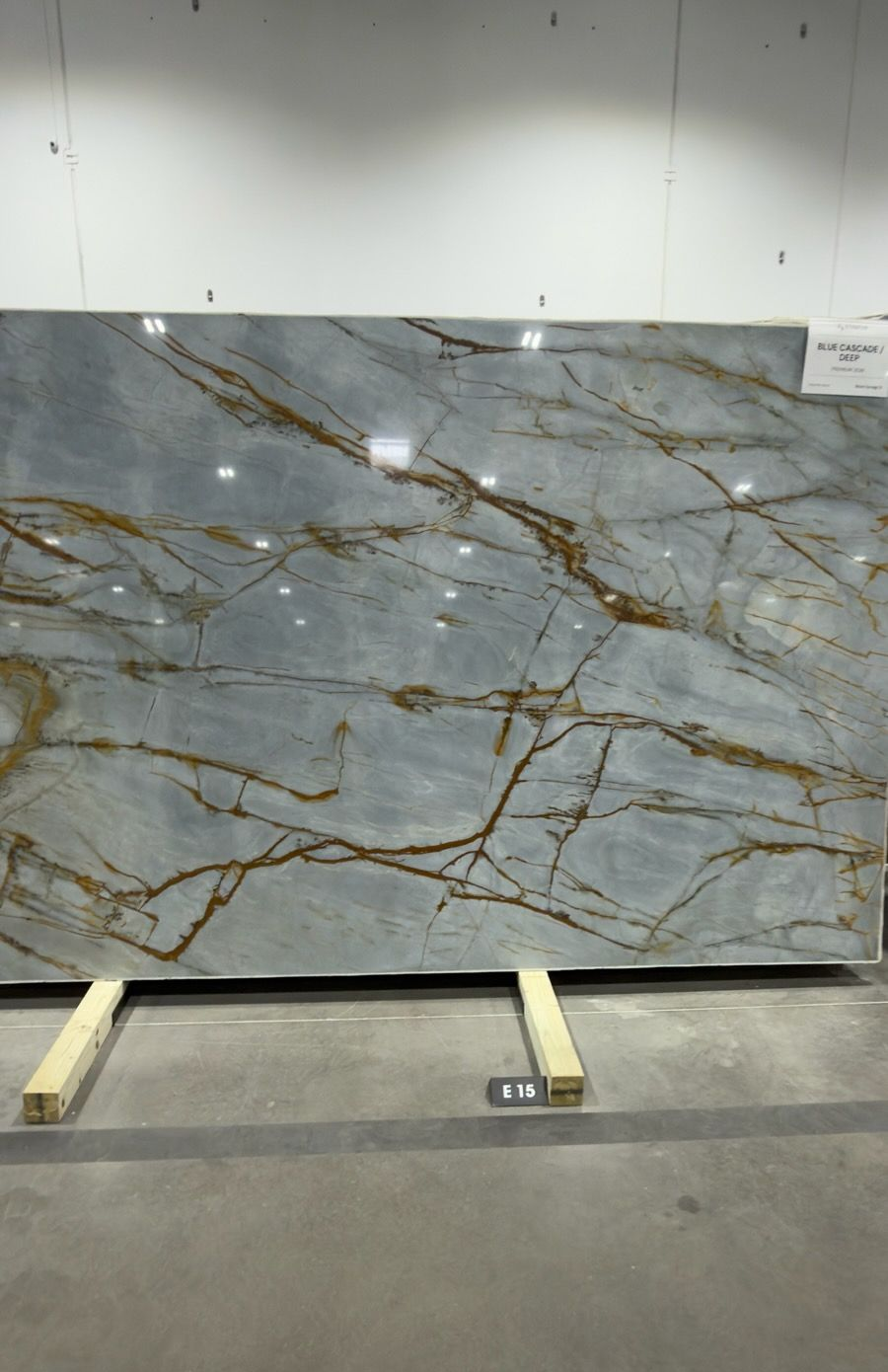
Why Natural Stone Installation Requires a Different Standard
Seam matching on natural stone is more demanding than on engineered material because the variation in veining and background tone across a slab is not repeatable—two pieces from the same quarry lot will not be identical, and adjacent slabs on a long kitchen run have to be oriented so the veining reads as a continuous movement across the joint rather than an abrupt pattern shift. Granite Store Direct manages this by mapping slab orientation during templating and marking reference points on each piece before fabrication, so the positioning decision is made before the stone is cut rather than improvised on site during placement.
Once the installation is complete, the observable result of properly handled natural stone is a seam line where veining flows across the joint without a visible color or directional break, edges that are consistent in depth and profile angle along the full run, and a sealed surface that does not show water absorption when liquid is left on the stone for several minutes. Undermount sinks in marble or quartzite countertops require clip spacing adjusted for the stone weight—natural stone is heavier than engineered slabs of the same dimension—and that load management is addressed during the fabrication stage so the installed sink carries its weight against the stone correctly from day one.
Clients undertaking luxury renovations in neighborhoods like Plano and Allen often choose marble for baths and quartzite for kitchens within the same project, which requires managing different sealing protocols and finish standards in the same installation sequence. Granite Store Direct handles that coordination as part of its natural stone expertise, with client expectation management on maintenance built into the project conversation before work begins rather than after the stone is set..
Questions Before Starting Your Natural Stone Project
These questions address how marble and quartzite installation is actually performed, what decisions are made during the process, and what clients will notice when the work is done correctly.
How is templating for natural stone different from templating for engineered quartz?
Natural stone slabs vary in thickness across their length—sometimes by several millimeters—so the template has to identify where shimming will be needed under the slab to keep the installed surface level. Engineered quartz is manufactured to uniform thickness, which simplifies placement. With natural stone, the shimming strategy is planned during templating so stress is not concentrated at one point when the slab is set.
What does penetrating sealer application involve during a marble installation?
A penetrating sealer is applied after the stone is set and all cut edges are exposed, because cut edges are more porous than the factory-finished face and absorb sealer at a different rate. The sealer is worked into the surface in sections, allowed to penetrate for the manufacturer-specified dwell time, and then buffed off before it can film on the surface. Application on cut edges requires a second pass because the first coat absorbs fully before the surface is saturated.
How is veining matched across a seam on a multi-slab quartzite installation?
Adjacent slabs are oriented at the templating stage by mapping where the veining direction exits one piece and enters the next, then cutting and positioning the slabs so those directional lines align at the joint. This requires selecting the cut line on each slab carefully—sometimes sacrificing material at the edges—to get the orientation right rather than simply cutting to dimension and placing.
What custom edge profiles are available for natural stone and how is the selection made?
Bevels, ogees, mitered waterfall edges, and laminated built-up profiles are all available. Selection is based on cabinet style, island scale, and slab thickness—a 2 cm slab requires a laminated build-up to achieve the visual weight of a 3 cm profile, which adds fabrication steps. The edge profile is confirmed before fabrication begins because changing it after cutting affects material allocation for the entire job.
What should you check in a finished marble or quartzite installation before accepting the work?
Verify that seam lines are flush with no height difference between adjacent pieces, that the sealer has been buffed off cleanly with no filmy residue on the surface, that sink clips are secure and the rim sits flush without flex, and that all exposed cut edges—particularly around cooktop and sink openings—have been sealed to the same standard as the countertop face.
Granite Store Direct brings natural stone expertise to marble and quartzite installations across Dallas, managing templating, sealing, edge work, and client expectation alignment from the first site visit through final placement. Call (817) 371-2316 to discuss your project and arrange an on-site measurement. Granite Store Direct also installs marble and quartzite countertops in Houston, San Antonio, and surrounding areas.