
Exotic Stone Installations Handled with Specialist Care
Patagonian stone countertop installation in Dallas for high-end kitchens and baths where exotic slab material demands precision handling and custom edge work
Patagonian stone—sourced from quarries in South America and characterized by its dramatic grey-and-white veining with occasional burgundy or blue mineral inclusions—occupies a category above standard imported granite or marble in both material cost and installation complexity. Granite Store Direct specializes in exotic stone installation for Dallas-area luxury renovations, with Patagonian stone projects handled by practitioners who understand that the crystalline structure of this material requires adjusted cutting parameters to avoid heat fractures along the vein lines during fabrication. That is not a concern that surfaces in everyday granite or quartz work, and a fabricator without exotic stone experience will not identify it until a slab is damaged.
Installation begins with precision templating that accounts for the full slab layout before any cuts are committed, because Patagonian stone arrives in limited quantities and slab-to-slab variation in background color and veining character means there is no easy replacement if material is wasted. Seam management on multi-slab projects is mapped at the template stage—determining where joints fall and how adjacent pieces are oriented relative to each other so the dramatic veining in this stone reads as a coherent visual movement across the counter rather than a disconnected pattern break. Custom edge profiles, undermount preparation, and final sealing protocol are all executed as part of the installation sequence.
Arrange an on-site consultation to review your kitchen or bath layout and determine how Patagonian stone slab dimensions will map to your specific counter configuration.
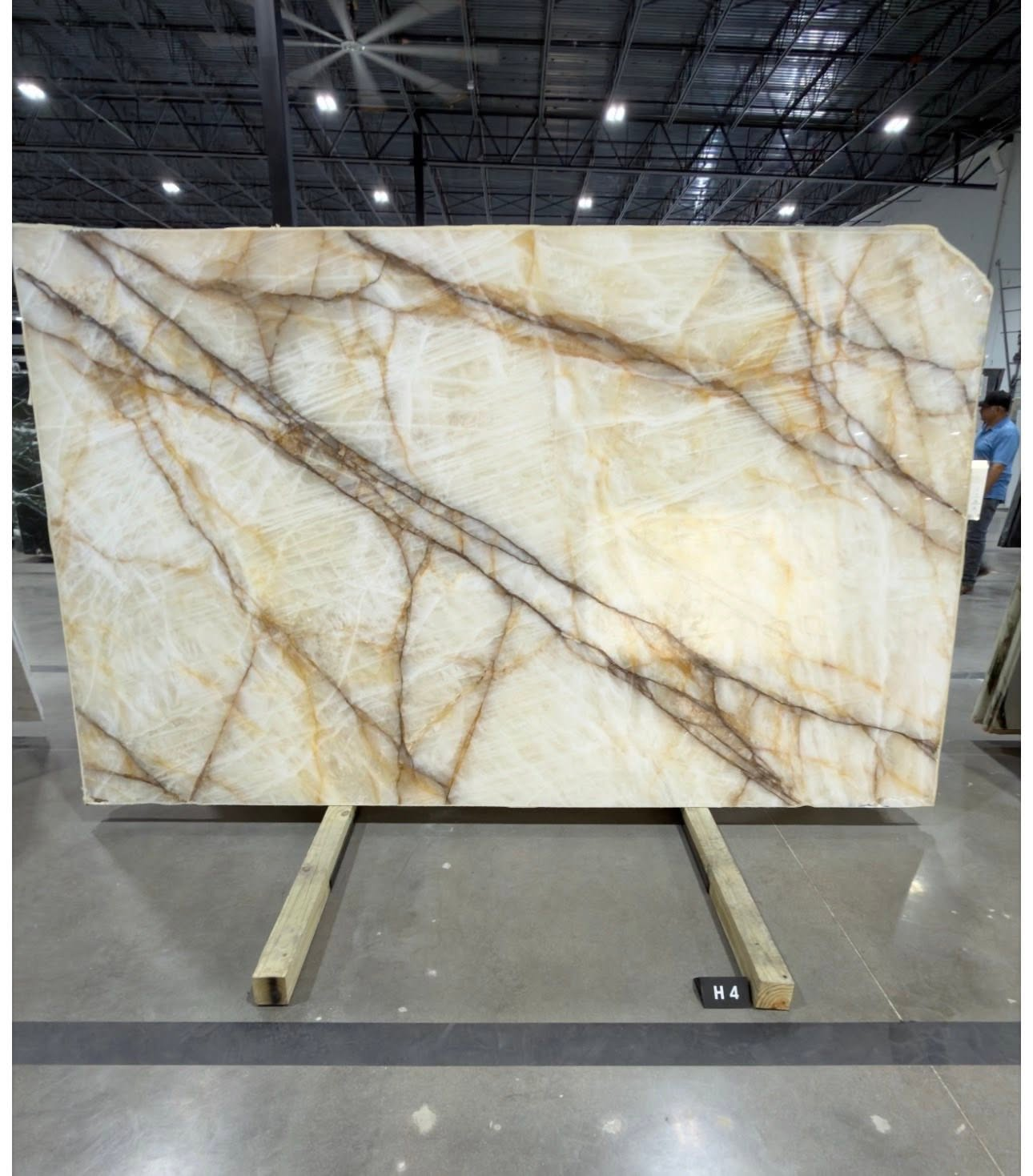
What Proper Exotic Stone Installation Requires
Patagonian stone's mineral composition produces a surface that takes custom edge profiles cleanly, but the vein lines—which run at angles through the slab rather than parallel to the surface—create stress concentration points during profiling if blade speed and feed rate are not adjusted for the material. Granite Store Direct's exotic stone process includes fabrication parameters matched to the specific stone type rather than applying the same tooling approach used on engineered quartz or softer imported granite. Custom profiles including bevels, ogees, and waterfall mitered edges are available, and the choice is confirmed before fabrication begins because the edge profile affects how much material is consumed at the perimeter and whether specific veining features in the slab face end up visible in the finished edge.
After installation, the visible result of a properly managed Patagonian stone project is a counter where the dramatic veining reads as a single compositional statement across the full surface—seams placed and oriented so the stone's movement continues through the joint without a visual interruption, edges profiled consistently in depth and angle along the entire run, and the surface sealed so it does not show differential absorption between the matrix and the vein material. Affluent homeowners in Flower Mound and Plano selecting Patagonian stone for open-plan kitchen islands want the slab to function as a design focal point, which requires that the installation execution match the material quality—a misaligned seam or inconsistent edge depth undercuts the visual case for the stone entirely.
Because Patagonian stone is an imported exotic material with limited re-supply windows, Granite Store Direct manages the installation process with a disruption-managed schedule that coordinates site readiness, cabinet completion, and plumbing rough-in timing before stone is transported, reducing the risk that delays in adjacent trades result in a fabricated slab sitting off-site while the installation window shifts. Undermount sink preparation is handled during fabrication so clip positions and cutout dimensions are finalized before the stone arrives at the job site..
Common Questions About Exotic Stone Countertop Work
These questions address how Patagonian stone installation is performed, what decisions are made during fabrication and placement, and what distinguishes a properly executed exotic stone job from one that compromises the material.
Why does Patagonian stone require different fabrication parameters than standard granite or quartz?
Patagonian stone's vein lines run at angles through the slab and create stress concentration points when a cutting or profiling tool crosses them at standard feed rates. Reducing blade speed and feed rate across those transitions prevents heat fractures along the vein—a failure mode that does not appear on the fabrication table but becomes visible as the stone settles under temperature variation after installation.
How is seam placement decided on a Patagonian stone kitchen installation?
Seam location is mapped during templating by identifying where joints can fall at a natural visual break—inside corners, transitions between a perimeter run and an island—and then orienting adjacent pieces so the veining direction exits one slab and continues into the next at the joint. On Patagonian stone, which often has strong directional veining, this orientation decision is more consequential than on uniform materials because a misaligned seam is immediately visible.
What sealing protocol is used for Patagonian stone and how does it differ from standard granite sealing?
Patagonian stone's mineral matrix includes areas of varying porosity between the background material and the vein inclusions, which means a single pass of penetrating sealer does not saturate the entire surface evenly. The sealing protocol involves a dwell-and-reapply sequence—applying sealer, allowing it to absorb fully in the more porous areas, and reapplying before buffing—so the entire surface reaches the same level of saturation rather than leaving the vein areas under-sealed.
What custom edge profiles work best with the visual character of Patagonian stone?
Mitered waterfall edges that carry the slab face down to the floor read particularly well with Patagonian stone because the veining continues through the edge and creates a three-dimensional compositional effect. Ogee and layered profiles also work, but require a 3 cm slab for the depth needed to execute the profile cleanly without laminating. The choice is confirmed before fabrication so the material allocation plan accounts for perimeter consumption.
What should be inspected in a finished Patagonian stone installation before the project is closed out?
Check that seam joints are flush with no detectable height step between adjacent slabs, that veining reads as continuous across each joint rather than mismatched in direction, that the sealed surface shows no differential absorption when water is placed on the stone for two to three minutes, and that all edge profiles are consistent in depth and angle without variation that would indicate a blade deflection during profiling.
Granite Store Direct handles Patagonian stone installation for high-end Dallas kitchens and baths with exotic stone expertise covering templating, fabrication, sealing, and custom edge work from start to finish. Call (817) 371-2316 to discuss your project scope and arrange an on-site layout review. Granite Store Direct also installs Patagonian stone countertops in Houston, San Antonio, and surrounding areas.