
Countertop Work That Holds Up to Daily Use
Quartz countertop installation in Dallas for kitchens, baths, and islands where precision templating and seam placement determine the finished result
Older ranch-style homes in established Dallas-area neighborhoods like Carrollton and Plano were typically built with tile or laminate counters on standard 25-inch cabinet runs—layouts that require careful re-templating when quartz is installed because cabinet runs in those homes often went in before drywall was squared, and walls are rarely plumb over a full run. Granite Store Direct handles quartz countertop installation across Dallas with a process built around precision templating before a single piece of stone is cut. That templating step is where a professional installation separates itself from a rushed one, because a template pulled from an out-of-square wall produces a slab that either gaps at the back or binds during placement.
Installation begins with a physical template drawn from the actual cabinet layout, not from architectural drawings, because as-built dimensions rarely match design documents in homes more than a decade old. On multi-slab runs—full kitchens, L-shaped islands, or bath vanities with returns—seam placement is determined at the template stage so joints fall at a logical break point and, where the stone has veining, adjacent pieces can be matched for visual continuity. Polished or honed finish application, edge work, undermount sink prep, and backsplash integration are handled as part of the installation sequence, not as separate contractor handoffs.
Arrange an on-site measurement to review your cabinet layout and identify any alignment or seam-placement considerations before fabrication begins.
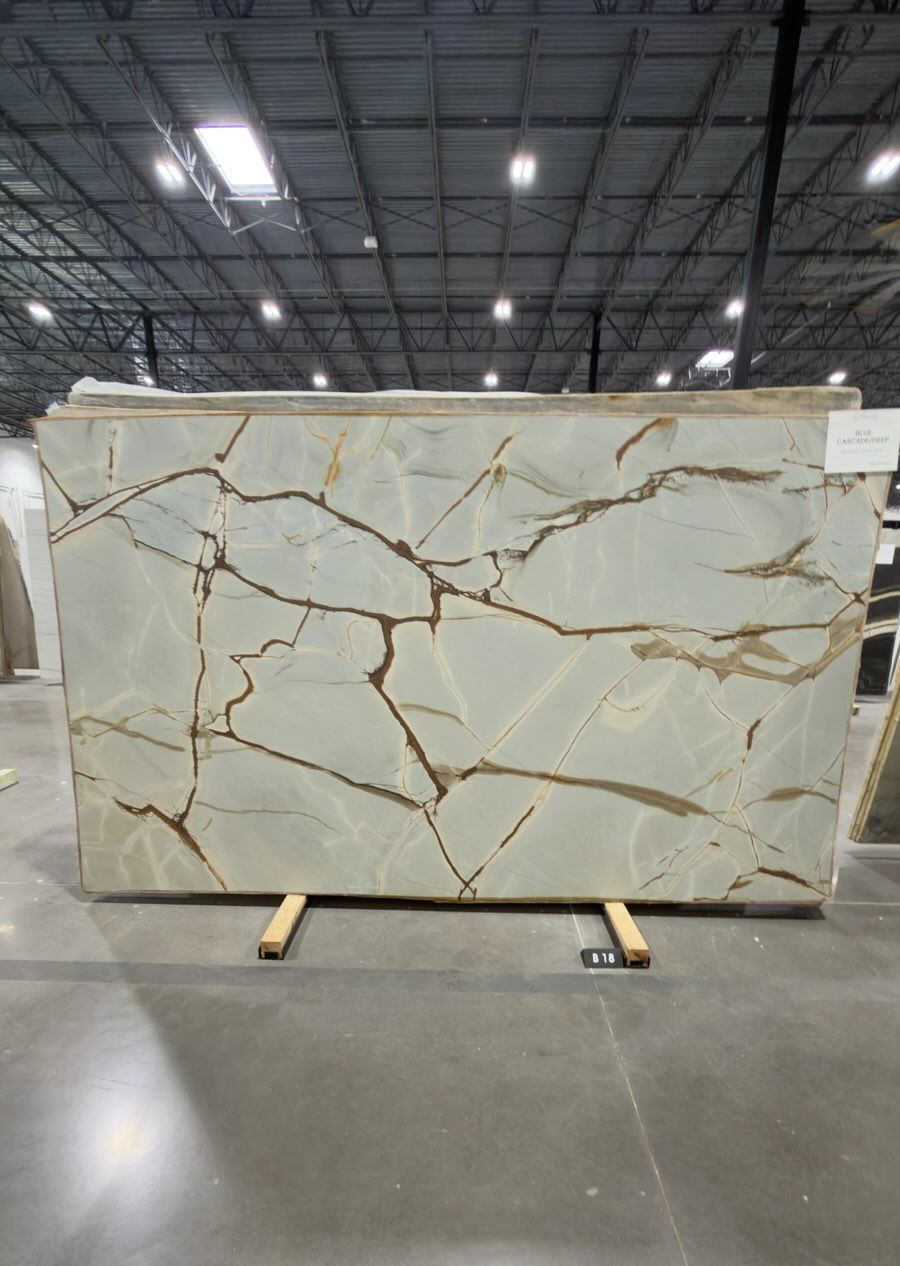
How Professional Quartz Installation Is Sequenced
After templating, slabs are fabricated to the confirmed dimensions with edge profiles cut before the stone is transported to the site. Transporting pre-profiled pieces rather than cutting on-site means the edge work is done on a stable fabrication table where depth and angle are consistent—field cutting an edge profile against a finished cabinet produces uneven results that are difficult to correct once the slab is set. Undermount sink openings are cut and reinforced during fabrication so the rim-to-stone interface is supported correctly before the countertop is placed and caulked.
Once installed, the observable change in a properly templated quartz job is that the back edge sits uniformly against the wall or backsplash without gaps that require excessive caulk to fill, seam lines between slabs are level without a detectable height step, and the undermount sink sits flush without the counter flexing when weight is applied near the cutout. Granite Store Direct's process on multi-slab installations includes seam matching—orienting adjacent pieces so any directional movement or color graduation in the engineered stone reads as continuous rather than mismatched at the joint.
Quartz does not require sealing the way natural stone does, but the installation process still includes a final inspection of all seam adhesive joints and edge-to-cabinet contact points before the job is signed off. Backsplash integration—whether the stone returns up the wall or a tile backsplash meets the counter—is addressed as part of the sequence so there is no open joint left for moisture to work behind the installation over time..
What Property Owners Ask About the Installation Work
These questions address how quartz installation actually unfolds on site, from templating through final placement, and what to look for once the work is finished.
Why is physical templating necessary even when kitchen dimensions are already on a design plan?
As-built cabinet dimensions in Dallas-area homes—particularly those built before 2000—often differ from design drawings because framing tolerances, drywall thickness, and cabinet shimming are never reflected in the original plan. A physical template captures the real geometry and prevents a slab from being fabricated to dimensions that do not fit the actual space.
How are seams managed on a multi-slab kitchen installation?
Seam placement is decided during templating by locating joints at natural break points—inside corners, transitions between runs—rather than wherever the slab ends. On stone with directional veining, adjacent pieces are oriented so the movement reads as continuous across the joint rather than abruptly changing direction.
What edge profile options are available and how does the choice affect the installation?
Eased, beveled, bullnose, ogee, and stacked profiles are all available, and the choice affects both how the counter reads at eye level and how much slab material is consumed at the perimeter. Thicker profiles like waterfall or stacked edges require additional material and affect how cabinet doors clear the counter face on full-overlay cabinet styles.
What does undermount sink prep involve during a quartz installation?
The sink opening is cut during fabrication, reinforced with adhesive clips bonded to the underside of the stone, and sized to the exact sink model so the rim seats flush. This is done before the slab is transported so the cutout edges are finished and the clip positions are set on a stable work surface.
What should be done if a seam is noticeably uneven after installation is complete?
A height difference between adjacent slabs at a seam indicates either a shimming error under one piece or a fabrication tolerance issue in the slab thickness. It should be addressed before the final caulk is applied, because caulk will not correct a step and will compress unevenly under use if the slabs are not leveled first.
Granite Store Direct manages quartz countertop installation from templating through final placement, with disruption-managed scheduling designed to keep your kitchen or bath functional during the process. Call (817) 371-2316 to schedule an on-site measurement and review your project requirements. Granite Store Direct also installs quartz countertops in Houston, San Antonio, and surrounding areas.