
Large-Format Slabs Cut and Set Without Compromise
Porcelain slab installation in DFW for countertops and wet areas where seam strategy, substrate preparation, and waterproofing determine long-term performance
Large-format porcelain slab installation involves a set of technical decisions that standard tile installation workflows are not designed to handle—full-slab layout planning, seam placement strategy relative to countertop edges and cutouts, substrate preparation for the weight and rigidity of the slab format, and waterproofing integration for bathroom applications. Granite Store Direct manages this scope for countertops and wet areas across the Dallas-Fort Worth area, including custom cuts for islands and peninsulas where layout geometry requires fabrication precision that prefabricated formats cannot accommodate.
DFW kitchens and bathrooms present specific installation conditions worth understanding before slab selection: the region's humidity variance affects substrate behavior, and bathroom applications in older Midlothian and Mansfield homes may require substrate correction before waterproofing layers can be properly applied. Porcelain's advantage in this context is that the material itself requires no sealing and tolerates humidity without the dimensional response that natural stone can exhibit—meaning the slab holds its installation dimensions across seasonal changes that would stress a porous material.
Request a free estimate to assess your existing substrate and confirm slab layout options for your countertop or wet area project.
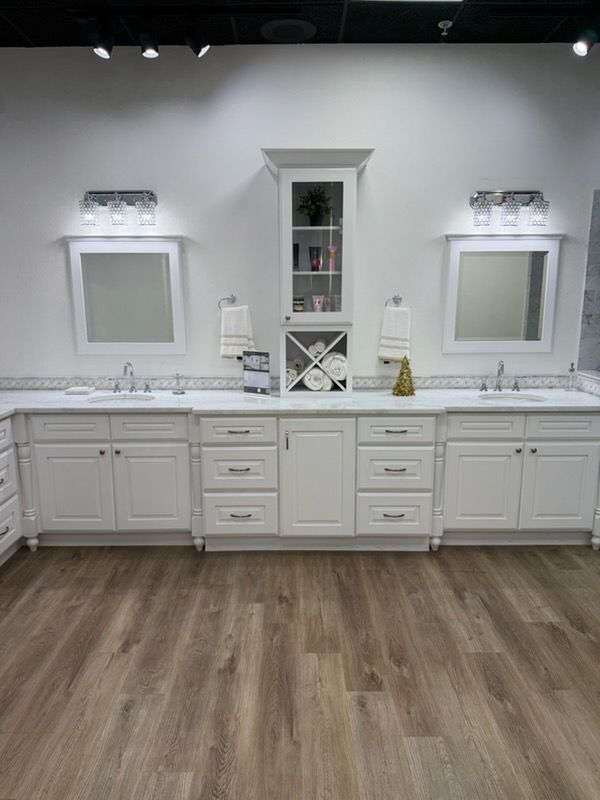
What Proper Porcelain Slab Installation Requires
The installation sequence begins with full-slab layout planning—mapping the slab's pattern or veining against the countertop or wall dimensions to establish where cuts fall and how seams will read visually. Seam placement for large-format porcelain is not a field decision made during installation; it is resolved during the planning phase so that fabrication cuts are positioned at structurally sound locations that also minimize visual interruption. For bathroom wet areas, waterproofing membrane application is completed before slab installation begins, and the substrate must be confirmed level and load-appropriate for the slab weight before adhesive is applied.
After installation, the surfaces you interact with daily show no grout lines across the countertop or wall field, and the slab presents as a continuous material rather than a tiled assembly. For kitchen island and peninsula configurations, custom-cut porcelain eliminates the edge inconsistencies that occur when prefabricated slab formats are trimmed in the field rather than fabricated to dimension.
Granite Store Direct also manages plumbing and drain rerouting when kitchen installation scope requires it—a coordination point that affects project scheduling and is handled internally rather than requiring the homeowner to engage a separate plumbing contractor mid-project. This matters specifically for kitchen reconfigurations where island placement or sink repositioning is part of the overall scope..
Common Questions About Porcelain Slab Projects
Large-format porcelain projects generate questions about process sequence, substrate requirements, and scope boundaries that smaller tile installations do not raise. The following addresses the specifics that affect DFW kitchen and bathroom slab projects directly.
How is seam placement determined for large-format porcelain slabs?
Seam locations are resolved during the layout planning phase based on slab dimensions, pattern continuity, and the structural requirements at cutout edges—not adjusted during installation after cuts have been made.
What substrate preparation is required before slab installation?
The substrate must be level, structurally sound, and appropriate for slab weight; in bathroom applications, a waterproofing membrane is applied before slab setting to prevent moisture migration behind the installation.
Why does DFW's climate make porcelain slab a practical choice for bathrooms?
Porcelain does not require sealing and does not respond dimensionally to humidity, which makes it stable in the moisture-variable conditions that North Texas bathrooms experience across seasons.
When should plumbing rerouting be addressed relative to countertop installation?
Plumbing rerouting must be completed before countertop installation if sink placement is changing—Granite Store Direct coordinates this internally for kitchen projects where the scope includes repositioning fixtures.
What custom cuts are available for island and peninsula configurations?
Porcelain slabs can be fabricated to precise dimensions for islands and peninsulas, including mitered edges and radius corners—these are fabrication decisions confirmed during templating, not field adjustments.
Granite Store Direct brings 26 years of countertop installation expertise to large-format porcelain slab projects across DFW, managing layout planning through final installation as a coordinated scope. Send your project details to begin the estimate and substrate assessment process.